Archive for the 'books' Category

Better thinking through chemistry

This chapter was due for inclusion in The Rough Guide Book of Brain Training, but was cut – probably because the advice it gives is so unsexy!

The idea of cognitive enhancers is an appealing one, and its attraction is obvious. Who wouldn’t want to take a pill to make them smarter? It’s the sort of vision of the future we were promised on kids TV, alongside jetpacks and talking computers.

Sadly, this glorious future isn’t here yet. The original and best cognitive enhancer is caffeine (“creative lighter fluid” as one author called it), and experts agree that there isn’t anything else available to beat it. Lately, sleep researchers have been staying up and getting exciting about a stimulant called modafinil, which seems to temporarily eliminate the need for sleep without the jitters or comedown of caffeine. Modafinil isn’t a cognitive enhancer so much as something that might help with jetlag, or let you stay awake when you really should be getting some kip.

Creative types have had a long romance with alcohol and other more illicit narcotics. The big problem with this sort of drug (aside from the oft-documented propensity for turning people into terrible bores), is that your brain adapts to, and tries to counteract, the effects of foreign substances that affect its function. This produces the tolerance that is a feature of most prolonged drug use – whereby the user needs more and more to get the same effect – and also the withdrawal that characterises drug addiction. You might think this is a problem only for junkies but, if you are a coffee or tea drinker just pause for moment and reflect on any morning when you’ve felt stupid and unable to function until your morning cuppa. It might be for this reason that the pharmaceutical industry is not currently focusing on developing drugs for creativity. Plans for future cognitive enhancers focus on more mundane, workplace-useful skills such as memory and concentration. Memory-boosters would likely be most useful to older adults, especially those with worries about failing memories, rather than younger adults.

Although there is no reason in principle why cognitive enhancers couldn’t be found which fine-tune our concentration or hone our memories, the likelihood is that, as with recreational drugs, tolerance and addiction would develop. These enhancing drugs would need to be taken in moderate doses and have mild effects – just as many people successfully use caffeine and nicotine for their cognitive effects on concentration today. Even if this allowed us to manage the consequences of the brain trying to achieve its natural level, there’s still the very real possibility that use of the enhancing drugs would need to be fairly continuous – just as it is with smokers and drinkers of tea and coffee. And even then our brains would learn to associate the drug with the purpose for which they are taken, which means it would get harder and harder to perform that purpose without the drugs, as with the coffee drinker who can’t start work until he’s had his coffee. Furthermore, some reports suggest that those with high IQ who take cognitive enhancers are mostly likely to mistake the pleasurable effect of the substance in question for a performance benefit, while actually getting worse at the thing they’re taking the drug for.

The best cognitive enhancer may well be simply making best use of the brain’s natural ability to adapt. Over time we improve anything we practice, and we can practice almost anything. There’s a hundred better ways to think and learn – some of them are in this book. By practicing different mental activities we can enhance our cognitive skills without drugs. The effects can be long lasting, the side effects are positive, and we won’t have to put money in the pockets of a pharmaceutical company.

Link to more about The Rough Guide book of Brain Training
Three excellent magazine articles on cognitive enhancers, from: The New Yorker, Wired and Discover

Cross-posted at mindhacks.com

The Rough Guide to Brain Training (Moore & Stafford, 2010)

The Rough Guide to Brain Training is a puzzle book which incluces essays and vignettes by myself. The book has 100 days of puzzles which will challenge your mental imagery, verbal fluency, numeracy, working memory and reasoning skills. There are puzzles that will look familiar like suduko, and some new ones I’ve never seen before. Fortunately the answers are included at the back. Gareth made these puzzles. I find them really hard.

I have 10 short essays in the book, covering topics such as evidence-based brain training, how music affects the developing brain, optimal brain nutrition and what the brains of the future will look like. As well as the essays, I wrote numerous short vignettes, helpful hints and suprising facts from the world of psychology and neuroscience (did you know that squids have dounut shaped brains? That you share 50% of your genes with a banana? That signals travel between brain cells at up to 200mph, which is fast compared to a cycle courier, but slow compared to a fibre optic cable). Throughout the book I try to tell it straight about what is, isn’t and might be true about brain training. I read the latest research and I hope I tell a sober, but optimistic, message about the potential for us to change how we think over our lifetimes (and the potential to protect our minds against cognitive decline in older age). I also used my research to provide a sprinkling of evidence-based advice for those who are trying to improve a skill, study for an exam or simply remember things better.

Writing the book was a great opportunity for me to dig into the research on brain training. It is a topic I’d always meant to investigate properly, but hadn’t gotten around to. The claims of those pushing commercial brain training products always seemed suspicious, but the general idea – that our brains change based on practice and experience – seemed plausible. In fact, this idea has been one of the major trends of the last fifty years of neuroscience research. It has been a big surprise to neuroscientists as experiment after experiment has shown exactly how malleable (aka ‘plastic’) the structure and function of the brain is. The resolution of this paradox of the general plausibility of brain training with my suspicion of specific products is in the vital issue of control groups. Although experience changes our brains, and although it is now beyond doubt that a physically and mentally active life can prevent cognitive decline across the lifespan, it isn’t at all clear what kinds of activities are necessary or essential for general mental sharpness. Sure, after practicing something you’ll get better at it. And doing something is better than doing nothing, but the crucial question is doing something you pay for better than doing something else that is free? The holy grail of brain training would be a simple task which you could practice (and copyright! and sell!!) and which would have benefits for all mental skills. Nobody has shown that such a task or set of tasks exists, so while you could buy a puzzle book, you could also go for a jog or go to the theatre with friends. Science wouldn’t be able to say for certain which activity would have the most benefits for your mental sharpness as an individual – although the smart money is probably on going jogging. It is to the credit of the editors at the Rough Guides that they let me say this in the introduction to the Rough Guide to Brain Training!

There wasn’t room in the book for all the references I used while writing it. This was a great sadness to me, since I believe that unless you include the references for a claim, you’re just spouting off, relying on a dubious authority, rather than really talking about science. So, to make up for this, and by way of an apology, I’ve put the references here. It will be harder to track specific claims from this general list that it would be with in-text citations, so if you do have a query, please get in touch and I promise will point you to the evidence for any claims I make in the book.

Additionally, I’ll be posting here a few things from the cutting room floor – text that I wrote for the book which didn’t make it into the final draft. Watch out, and if you do get your hands on a copy of this Rough Guide to Brain Training, get in touch and let me know what you think.

Amazon link (only £5.24!)
Scientific references and links used in researching the book
Cross-posted at mindhacks.com

Ad Nauseam

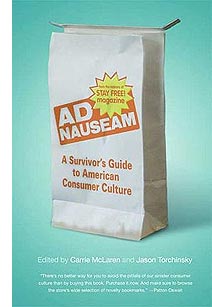
adnauseam I am reading Ad Nauseam: A Survivor’s Guide to American Consumer Culture, edited by Carried McLaren and Jason Torchinsky. The book is a funny, smart and sometimes shocking collection of articles from Stay Free Magazine and blog. I first came across Stay Free when I was researching the psychology of advertising and was impressed by their sophisticated take on how adverts affect consumers’ decision making. They discuss in Ad Nauseam how advertising is often misunderstood, with people relying on an intuitive ‘Advertising doesn’t effect me’ view or swinging to the opposite extreme of the ‘Sinister Advertisers Manipulate Consumers with their Mind Control Tricks’ position. Both positions distract from the very real, but not magical, power of advertising.

The book has a great discussion of Wilson Bryan Key’s Subliminal Seduction, the book that launched the idea that subliminal, and often sexual, figures are embedded in random features of adverts such as in ice cube shadows. The idea of these ‘embeds’ is nonsense, of course, but great fun to look for and a great distraction from the real persuasive content of the advert. The book also has a chapter on the origins of modern advertising practice in 19th century pharmaceutical advertising (the manufacturing of ailments for which ready made ‘cures’ can be sold has been covered by Vaughan on mindhacks.com before, in relation to the mental health). Packed with critical analysis of the advertising industry, more informative history and some shocking examples of how consumerism has worked its way into many aspects of our daily lives, this book is essential intellectual self-defense, managing to be critical and aware without ever being sanctimonious or hysterical.

Cross-posted at mindhacks.com

Emotional Cartography book launch talk

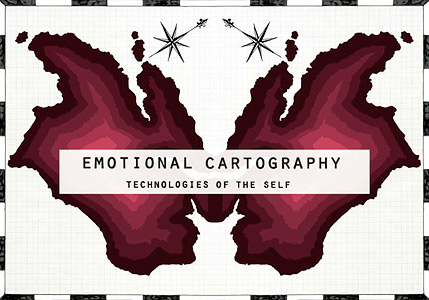
The Emotional Cartography book launch was on friday and went off a treat. Since I had, unusually for me, planned my talk by writing it out in full I have reproduced it below. This is more-or-less what I said:

There is a saying that those who want to enjoy laws and sausages should not find out how they are made. I think the same is true about facts. Or rather I think that anyone who wants to believe in simple honest facts, objective lumps of knowledge which are true and eternal, ought to stay away from the places where facts are produced. When you see how facts are made you ought to gain, I believe, a healthy scepticism about how they are used.

I am a scientist — an experimental psychologist — and I work in a University. In the University, in the Faculty of Science, we like to think we are the factory of facts. Yet, it still surprises me that some of my colleagues still believe in simple honest facts, even after years in the workrooms squeezing the meat of messy reality into the offal tubes of truth. Many times I’ve been faced down by these colleagues who refuse to believe that some complex social or political dilemma is really problematic. “Just find out the facts” they say. “When we know the facts, what do — about schools, israel-palestine, whatever — will become obvious”

Curious that anyone who has seen facts being made can still believe that on their own they’ll help!

I’m reminded of another quote, this one by Matt Cartmill – Professor of Biology, at Duke University. He said,

“As an adolescent I aspired to lasting fame, I craved factual certainty, and I thirsted for a meaningful vision of human life – so I became a scientist. This is like becoming an archbishop so that you can meet girls.”

Now don’t get me wrong, facts do exist. We look to the stars and ask if things can be known — can things be known? And things can be known. There is right and wrong, true and untrue. Facts, in this sense, do exist. But they aren’t enough for a balanced intellectual diet.

I think facts are seductive because they take a lot of technical skill to produce. If you want to make even a basic truth which will hang together long enough to survive being passed around, you need a lot of disciplinary training. You need expensive and complex measuring equipment, you need esoteric statistical techniques and you need to make the right comparisons. All this takes time and money and a lot of discipline specific experience. No wonder scientists are proud of their facts, and the facts themselves invoke some envy and respect.

The problem is that facts always — always! — come with a set of presumptions, they always come along with a view of the world that they promote.

If you’ve read Thomas Pynchon’s ‘Gravity’s Rainbow’, his sprawling riotous novel of wartime paranoia you might know one of his Proverbs for Paranoids: “If you can get them asking the wrong questions, you don’t have to worry about the answers”

To stop this getting too abstract, and to bring it back to the book that we’re gathered here to launch, let’s talk about maps.

Everyone interested in maps should read Dennis Wood’s “The Power of Maps”. I believe this so strongly I have forced myself to only say this once, so that was it.

I read this book while I was working on a thing called the Sheffield Greenmap. Greenmaps are community mapping projects designed to mark environmental and community sites in a local area. Dennis Wood talks about the selective accuracy of maps, how they show one part of the world, and can seduce you into thinking (because of the professionalism of their accuracy) that their representation is the way to view the world. But, he said, “Accuracy is not the issue. Selectivity is the issue”. Perhaps because I was involved with the Sheffield Greenmap project these words of his resonated with me very strongly. Maps are choices about how to view the world. When I looked at maps of my hometown, maps which I would happily point to and say “this is Sheffield”, I saw the one way roads marked, the petrol stations. The base I used for the greenmap of the area around the University was based on the University’s own map. Running up the hill from the University in Sheffield is a road with parks either side of it. When I came to look at the University map, I noticed, for the first time, that only one of the parks was marked. The road, you see, was also a socio-demographic division between the leafy suburb of the university and the estates next door. For the University, the park next to the estates didn’t exist (or at least not as a place for students and University visitors to go).

The greenmap project made me look at the maps of Sheffield and ask why what was on them was on them. Why the roads and the petrol stations, why not the scenic routes through park, the community cafes and the places you could lock your bike up?

Accuracy wasn’t the issue. Selectivity was.

Wood discusses the ‘general purpose’ map as a particularly insidious example of interests using maps to mask their interests. The generality, the lack of explicit purpose, in a map disguises that it represents the end of a careful and directed process of selection. Like the scientific facts, the beauty of the technical process can blind you to the bias inherent in the construction.

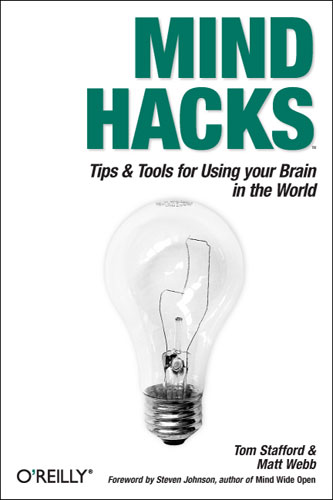
I was invited to contribute to the Emotional Cartography because of Mind Hacks, a book I wrote with Matt Webb and a few valiant contributors in 2004. Mind Hacks is a collection of 100 do it yourself experiments that you can try at home and which reveal something about the moment-to-moment workings of your mind and brain. Our ambition with the book was to perform a smash and grab on the goodies of cognitive neuroscience, to open source some of the fascinating science that has been done, turning it into demonstrations which anyone could try. We wanted to make some of what was known about the mind available to be re-purposed by other people. So designers, artists, educators and whoever could notice and reuse various principles of how our minds make sense of the world.

Lately I’ve come to think — and this was inspired by writing the chapter in Emotional Cartography — that the view of the mind we took in Mind Hacks was limited. And this limitation reflects that of academic psychology as a whole. We focussed on the perceptions, thoughts and feelings of isolated individuals, rather than of people in their full social context, in interaction with others.

This is why I’m excited about Emotional cartography. It takes the idea of open-sourcing the production and consumption of facts to the social level.

First, emotional cartography. We’re a visuo-spatial species. We love sights, spaces, exploring with our eyes. We reify this prioritisation into maps, which are themselves inherently visuo-spatial. If you believe that maps are a kind of technology for thinking with, which I do (my chapter in the book is about this), then this is turn makes it easier to think about the kinds of things which are easiest to show on a map. The maps of physical space then make this selection bias invisible, by pretending to be natural.

Emotional Cartography makes another kind of information mappable, and this opens up the space to think with and debate about what that mapping makes explicit. For example: why are people anxious or excited in this place? Is that something we should do something about?

The other reason I’m excited about emotional cartography is because, truly, it opens up a space for emotional cartographies — a refocussing on the process of mapping and remapping. By open-sourcing mapping it allows mapping to be a processes rather than a product and this powerfully opens up space for people to take part in the negotiation of the representation of their own geographical spaces. Rather than one true map of a locale, there are many maps, and these maps can be a medium for the mappers to meet and discuss their feelings, the places where they live, and the interrelation of these two things.

So let me finish by congratulating Christian on his idea and all his hard work which resulted in this book, let me congratulate the other authors for their contributions and let me commend to you the practice of emotional cartography because, as should be obvious by now, in all areas of life, including map making, I believe it is far more satisfying to be a participant than a mere consumer.

Emotional Cartography book launch

Tonight we are launching ‘Emotional Cartography – Technologies of the Self’, an edited collection inspired by Christian Nold’s project of making maps of individual’s emotional responses in different areas. Christian edited the volume, which has a contribution by me (the last chapter) on the how technology can augment how we think. Tonight we’re having a book launch at which myself, Christian and Sophie Hope will speak. If it’s not too late notice, you’re welcome to come down.

books read in 2005

As requested by Cat, the books I read in 2005. Strong recommendations in bold.

An Ordinary Person’s Guide To Empire. Arundhati Roy (2004). Jan
A Thousand Years of Non-linear history. Manuel de Landa (1997). Feb
(presumably I read some other books Feb-May but I’ve lost the list)
The Origins of Virtue, Matt Ridley (1994) 18 June
Persepolis, Marjane Satrapi (2003) 20 June
Beyond the Ballot: 57 Democratic Innovations From Around the World, Graham Smith (2005) 29 June
The Great Divorce, CS Lewis (1946) 30 June
The Amber Spyglass, Philip Pullman (2000) 3 July
Iron in the Soul, J.P. Sartre (1949) 21 July
Fountain at the Centre of the World, Rob Newman (2003) 4 August
Things Can Only Get Better, John O’Farrell (1999) 5 August
Fierce Dancing, CJ Stone (1996) 7 August
It’s a Lot Like Dancing: Aikido Journey, Terry Dobson, Riki Moss, and Jan E. Watso (1994) 8 August
Broke Through Britain, Peter Montimer (1999) 20 August
The Perfect Storm, Sebastian Junger (1998) 26 August
Down and Out in Paris and London, George Orwell (1933) 2 Sept
The No-nonsense guide to the arms trade, Gideon Burrows (2002) 2 Sept
The Corporation, Joel Baklan (2005)
Toxic Sludge is Good for You, John Stauber and Sheldon Rampton (2004)
We Know What You Want, Martin Howard (2005)
The Hidden Persuaders, Vance Packard (1959)
The Thought Gang, Tibor Fischer (1994) 8 Nov
Diary, Chuck Palahniuk (2003) 9 Nov
The Wind-Up Bird Chronicle, Haruki Murakami (1997) 17 Nov
The Next Fifty Year, John Brokman (ed, 2003) 29 Nov
Willing Slaves, Madeleine Bunting (2004)
Liar’s Poker, Michael Lewis (1990)
Cassini Division, Ken McLeod (1998) 23 Dec
The Paradox of Choice, Barry Schwartz (2004)
Party’s Over – Oil, War and the Fate of Industrial Societies, Richard Heinberg (2005)

List for 2008 here. Top three from 2005: The Corporation, Paradox of Choice, A Thousand Years of Non-linear History.

books read in 2008

Following Matt, and after being asked by Tom, here is the list of books I read in 2008. The ones I strongly recommend are in bold.

Middlemarch, George Eliot (1871) 17 Jan
The Improvisation Game, Chris Johnston (2005) 26 Jan
Prisoner’s Dilemma, William Poundstone (1992) 2 Feb
Secrets of Creation: Vol 1: The Mystery of the Prime Numbers, Matthew Watkins (2008, proofs) 5 Feb
Brainwashing: The Science of Thought Control, Kathleen Taylor (2004) 7 Feb
The Shock Doctrine, Naomi Klein (2007) 17 Feb
Breakdown of Will, George Ainslie (2001) 12 March
Meditations, Marcus Aurelius (180) March
Kluge, Gary Marcus (2008) 8 April
V, Thomas Pynchon (1963) April
The Map of Love, Ahdaf Soueif (2000) 23 May
Permutation City, Greg Egan (1994) 10 June
Meaning Medicine and the “Placebo Effect”, Daniel Moerman (2002) 8 June
Fragile Things, Neil Gaiman (2006) 15 June
Wonder Boys, Michael Chabon (1995) 21 June
Better: A Surgeon’s Notes on Performance, Atul Gawande (2007) 28 June
My Uncle Oswald, Roald Dahl (1979) 28 June
Sin City: Hell and Back, Frank Miller (2005) 6 July
Divided Kingdom, Rupert Thomson (2005) 18 July
Micromotives and Macrobehaviour, Thomas Schelling (1978) 15 July
Nights at the Circus, Angela Carter (1984) 25 July
Standloper, Alan Garner (1996) 17 August
Impro for Storytellers, Kieth Johnstone (1994/99) 18 August
Sight Unseen, Goodale & Milner (2004) 24 August
The Wretched of the Earth, Franz Fannon (1963) 23 August
Neither Victims Nor Executioners, Albert Camus (1946) 24 August, r.
The Crying of Lot 49, Thomas Pynchon (1965) 30 August
The Virago Book of Fairy Tales, Ed. Angela Carter (1990) 31 August
The Wind-up Bird Chronicle, Haruki Murakami (1994) 7 September, r.
Man’s Search for Meaning, Viktore E. Frankl (1945/1959) 8 September
The Science of Self-Control, Howard Rachlin (2000) 18 September
Al Qaeda and What it Means to be Modern, John Grey (2003) 5 October
A Scanner Darkly, Philip K. Dick (1977) 16 October, r.
Full Facts Book of Cold Reading, Ian Rowland (2002), 20 October
The Elfish Gene, Mark Barrowcliffe (2007), 25 October
Moominvalley in November, Tove Jansson (1971), 30 October
Nixon Under the Bodhi Tree, Kate Wheeler (ed., 2004), Nov
All the Pretty Horses, Cormac McCathy (1992), 11 December
Active Vision, Findlay & Gilchrist (2003), 28 December

39 is a lot less that Matt’s 104, but I reckon my commute is about fifty minutes less than his, and its hard to read while cycling :-)

It’s about 50-50 fiction/non-fiction, but I reckon I spent most of the time on non-fiction since it is slower going. My top two would be ‘The Shock Doctrine’ and ‘Sight-Unseen’. A top three is too hard.

No One Makes You Shop at Wal-Mart

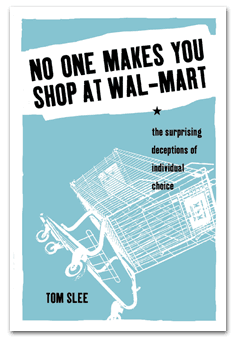
Cover of “No One Makes You Shop at Wal-Mart: The Surprising Deceptions of Individual Choice”

I have been seriously impressed by Tom Slee’s book “No One Makes You Shop at Wal-Mart: The Surprising Deceptions of Individual Choice”. It’s an accessible guide to economic game theory and an impassioned critique of market popularism. Slee is obviously an activist, but also has a measured, academic approach to economic theory. What is great is that he uses standard economic theory and simple illustrations to make a case for the necessity of collective action for solving our problems. It shows how far MarketThink dominates popular discourse that such a minimal plea comes across as radical. “No One Makes You Shop at Wal-Mart” is a lively and intelligent guide to how good individual choices can lead to regretable outcomes, and the ideas in it are essential tools for intellectual self-defence.

Book website www.web.net/~tslee/

Blog of the book whimsley.typepad.com/

Questions for economists

Tim Harford wrote ‘The Undercover Economist’ and also writes the ‘Dear Economist’ column for the Financial Times. His book is excellent — a very readable introduction to economic theory and how it applies to various facets of everyday life. I was going to write him a letter, but then I found out that he’d sold half a million copies of his book and so, reckoning that he’d be too busy to write back to me, I am posting my thoughts here. This is partly for my own benefit as a note-to-self and partly because I’d be very happy to get answers from anyone or everyone on the questions I ask. Useful references are an acceptable substitute for wordy explanations.

Dear Undercover Economist,

On development — can everyone be rich? Won’t there always have to be someone to work the fields / clean the toilets / serve the coffee? Technologists answer: automatisation will remove much of life’s drudgery. Environmentalist retort: resources put limits on growth. Economists: imagine a world where every economy is ‘developed’. In that world we would expect to find people are wealthy according to their talents (because talents define scarcity). My question : in that world, what will the utterly talentless be paid to do with their time? Presumably we’ll still be forcing them to clean toilets, because the toilet-cleaning robots will be too expensive (they need to be in order to pay the wages of the very-expensive-to-hire toilet-cleaning-robot designers).

Information asymmetry: Akerlof (1970) has a description of how information asymmetry can prevent a viable market existing. Harford’s discussion credits to information asymmetry the reason why you can’t get a decent meal in tourist areas, but I am wondering if the effects are far more wide reaching that this. Big organisations will have an information advantage over individual consumers (on some things), as will anyone who devotes their entire economic energy to a single domain (eg selling avocados) over someone who is time poor (eg the typical avocado buyer). Coupled with a dynamic economic environment, couldn’t those with informational advantage effectively manipulate those with informational disadvantage? In other words, i’d be willing to bet that in a static market even an extremely informationally-deprived / cognitively challenged agent will work out the best deal, given enough time. But if the best deal keeps changing (and those with the information advantage keep changing it to suit their ends) the chances of the individual agent aren’t so good. File under benefits of collectivisation / market failure?

Efficiency of the market leads to loss of diversity (because all inefficient solutions are squeezed out). Diversity has it’s own value, both in system robustness (see ecosystems) and in terms of human experience (belonging to a specific place, variety being the spice of life, etc). So how do we incorporate the value of this diversity into market systems? I would submit that diversity is an example of something that exists above the single-agent view of things — is an example of an emergent phenomenon (see below). (Previously on idiolect Why is capitalism boring?)

Markets don’t have foresight. Do free marketeers admit that this is one of the functions of government? For example imagine agents who like to consume some finite resource. Presumably a ‘free market’ will be the most efficient way to organise their consumption. Efficient consumption of the resouce leads to its disappearence. Then what? In the Undercover Economist (p237) Harford says that in markets ‘mistakes cannot happen’ because any experiments with resources stay small scale. I would submit that while this is true at the micro level, with respect to efficiency — in other words, I agree that markets tend to efficiency — this is not true at the macro level, with respect to whole-system health.

An objection to this is that markets do have foresight because the individual agents have foresight – so they will incorporate into their cost function the anticipated future (so, eg, anticipated future resource availability). But what is agents do not have the information, or motivation to worry about the future? Does my concern just resolve down to the existence, or not, of the tragedy of the commons? Perhaps. I think key is the existence of a discontinuity between agent-level information and collective-level information; ie the issue is really about emergence, which is what the tragedy of the commons is really a specific example of.

Side note: if you are a market economist you are a de facto fan of emergence. Aggregate effects which emerge from mass individual action = emergence. Disconnection between individual goals (eg profit) and collective outcomes (efficiency). Etc. Economics is interesting precisely because their are non-obvious relations between agents and outcomes.

Side note the second: there is an essential similarity between economics and cognitive psychology – a focus on information processing. Further, market economics recognises the power of distributed information processing, as does the connectionist school of cognitive psychology. This is the reason I talk about agents, rather than consumers. I believe that the same principles will not just apply to the economic and social sciences, but also to the social sciences (remember Minksy’s “Society of Mind”). A question: can we usefully apply the idea of a distributed, free, ‘informational economy’ to undestanding neural coding? (Remember Glimcher’s “Neuroeconomics”)

Unspeak, by Steven Poole

I have just finished Steven Poole’s Unspeak, which is an excellent, impassioned, bitingly funny review of the way words are used to promote particular views of the world.

“Words have consequences in the world”, argues Poole in the epilogue, “…Unspeak itself does violence to meaning. It seeks to annihilate distinctions”. He explicitly distances himself from Lakoff’s ‘language frames’ view, where “the framing of the debate determines who will win the debate” (Howard Dean) and the only defense is prmote an alternate frame (to reframe). This, says Poole, will only lead to a clash of Unspeaks, rather than fostering any kind of sober dialogue. Poole quotes Ranko Bugarski: “What is needed [is the] judicious use of normal language, allowing for fine-grained selection and discrimination, for urbanity and finesse”. An admirable aim in hysterical times!

Steven Poole’s Upspeak website

John Quiggin review of Unspeak at Crooked Timber

words

remembering cycling down the hill last night. Empty streets, it hadn?t rained yet and the distant street-lights across the city looked like cold lost jewels. Knowing this run, this curve, this curb which affords a jump and then the switch to the other side of the road to keep the racing line. Pushing the speed all the time, not racing anyone, not being timed, but always trying to accelerate, always peddling, even though it?s downhill. Braking at the corners, leaning into the turn, feeling the tug of the motion as you swerve out of it and lean the other way. Throwing weight and speed and will into this next jump, the wheels spin on air ? a moment of divine suspension ? and then touching down, feeling the bite of the ground and starting to pedal again at that absolutely right and correct instant. A singular object racing without thought over an urban playground. Knowing and feeling all the contours and lines of the ground moved over, responding to the opportunities it gives for your energy to hurtle over it, pitching forward to the next opportunity. Then -Red lights and the world forcing you to a stop, just so it can catch up. Breathing in, everything still buzzing, in alert repose waiting for the starting light?and?.go!

Edinburgh Round-up

For what it’s worth…

friday>

Puppetry of the Penis – After the guys had taken their clothes off: “I really hope no one in the audience is thinking ‘So where are the puppets’”

saturday

Switch Triptych – From the Riot Group who stirred controversy with their ‘Anti-war’ Pugalist Specialist. Set in a telephone exchange, circa 1919, and circling themes of modernity, corporatism and mechanisisation. Excellent stuff

The Exonerated – Made from the real testimony of six people wrongfully convicted, sent to death row and later exonerated. If it is possible for something to be extremely moving and also cheap – in the sense of too easy – this is it.

Shane Koyczan – Performance poet. A-maz-ing. A cross between ani difranco and leonard cohen.

sunday

Dick Taverne, ‘Science and Society’ – Promoting his new book ‘The March of Unreason’, Dick rails agains the rising tide of irrationality and emphasises the fundamental entanglement of science and democracy. Fair nuff, but i think he’s a little unfair to those who buy into things he views as nonsense. Getting the proper scientific low-down on a topic is reserved for a privilaged view – privilaged in terms of time, and in terms of education/enculturation. Dick might have time to read 2,400 page reports on climate change, but most of us don’t. To say “We know this is nonsense, this-and-that many respectable scientific authorities say it is” is insufficient for those of us trying to make sense of things without the privilages of time and position that enable us to look into it fully, and it’s also profoundly undemocratic, since his injunction to believe the scientific establishment basically amounts to the same old mantra of “Leave it to the chief, trust authority, don’t think for yourself”. Oh and he also said that organic farming is a con, pesticide residues are harmless (so why do people get Parkinson’s Disease?) and that no one in the developing world opposed globalisation. What, no one?!

Give up! Start Over! (In the darkest of times i think of Richard Nixon) – A sweaty, physical, cut-up of speeches by richard nixon, Baudrillard’s Simulacra and Simulation and ‘Reality TV – An Inside’s Guide’. This is an intense work-out/meditation on the construction of reality and celebrity in our television culture. Left my head so full i had to sit and do nothing for about the next three hours. Just blew me away. “Be yourself. Or the most easily typecast version of yourself” “Your fifteen minutes – or point two megabytes -of fame” “In the language of intimacy”

Poppycock! – passed the time

A thousand natural shocksGive up! Start over! was so good i went to the other show by the same group, which seemed to have less center to it, and hence (at points) descended into the kind of avant-garde theatre it would be just impossible to paraody

Rob Newmnan , Apocalypso Now – Bill Hicks meets chomsky. Good god this man is funny and clever. Perhaps the second best thing i saw after Give up! Start over!. “If you’ve nothing to hide you’ve nothing to fear – or, as it is also known, everyone who is worried about being persecuted should be perscuted” “I’m not saying it was the cause for war, just a cause for war – part of a nexus of loosely connected interacting causal forces. That’s my new catchphrase”

Radioshow – showing sometime on radio four in the 11pm comedy slot. Was funny

Er…that’s it for shows. I drunk a load of booze and black coffee too. Edinburgh is way cool – it’s like the Berlin of the UK, I could definitely live there.

Making words needed

Part of any good advice on writing is to cut everything that isn’t doing some work. As the classic says ‘Omit needless words’, ‘Vigourous writing is concise’.

It occurs to me that sometimes, especially with scientific writing, that rather than have a choice of what to include and what to omit, you have a fixed number of ideas to include and your task, as a writer, is the mirror of the maxim above. Rather than ‘omit needless words’ you must find a way to make needed the words/ideas you are compelled to include. Any advice on how to do this would be appreciated.

the evening redness in the west

In the future, when the world is better organised, when children come of age, we will let ones who’ve been good read Cormac McCarthy’s Blood Meridian, we’ll tell them that, because they’ve been good, they get to meet the judge. When the ones who have been bad come of age, we’ll make them read Cormac McCarthy’s Blood Meridian, we’ll tell them that, because they’ve been bad, they get to meet the judge. His feet are light and nimble. He never sleeps. He says he’ll never die.

This book is simply fantastic, in a blood and dust, Moby Dick meets McCabe And Mrs Miller, gore and unrectified night, kind of way. So man loves games? Then let him play for stakes

The Doctrine of DNA

And some more from Lewontin’s The Doctrine of DNA

The transfer of causal power from social relations into inanimate agents that then seem to have a power and life of their own is one of the major mystifications of science and its ideologies

Which is an as readable, and enjoyable, argument against genetic reductionism as you could hope to find. I’m guessing that many people would say their reductionism is a methodological tactic rather than a ideological commitment, but Lewontin’s characterisation of popular discourse is accurate enough, i fear, to convince that however tactical genetic reductionism may be when adopted by scientists it becomes far less self-conscious as it migrates into the public sphere.

[note to self: avoid writing sentences that long and convoluted in the future]

Anyway: yes, society is not a reflection of individual level traits. Yes, organisms and environment co-create. Yes, locating causes in a single physical matter (like DNA) allows us to ignore the wider causal context. There’s lots to nit-pick about Lewontin’s arguments, but without the anchor of some particular example i think it would get so lost in the rhetorical and connotive terrain that it wouldn’t be worth it. Highly recommended

The Other Tom Stafford

A friend writes:

if you click on ‘tom stafford’ on the amazon page for pre-ordering Mind Hacks,
you get a link to your other book. You know, the one you wrote when you were
minus three, about the space race.

And it’s true. The other Tom Stafford is an astronaut who flew on Apollo 10, amongst others. For a while he was top of google for a search on ‘Tom Stafford’, but i tipped him off the top spot.

Incidentally, he’s also quoted by my favourite band, the New Model Army (who are playing in manchester on the 16th of December, by the way). On their song Space from the album Impurity, Joolz reads this quotation by the astronaut:

The white twisted clouds and the endless shades of blue in the ocean make the hum of the spacecraft systems, the radio chatter, even your own breathing disappear. There is no cold or wind or smell to tell you that you are connected to Earth. You have an almost dispassionate platform – remote, Olympian and yet so moving that you can hardly believe how emotionally attached you are to those rough patterns shifting steadily below.

So there you go

Mind Hacks pre-order

Mind Hacks is now available for pre-order, e.g. from Amazon (.co.uk and .com)

Morals on Copyright

The great thing about trying to coordinate book production over three continents is that whatever time of the day or night it is, there is always someone you can ring. I just wish we were working with more people in Japan so I’d have more to do in the hours when the Americans have left work but the Europeans haven’t got up yet.

I’ve hit a momentary lull, so here are some mental notes-to-self on the business of getting permission to reprint figures and excerpts from other people’s books, articles and websites (I am not a lawyer, so there may be errors in my understanding here – it’d love to hear any corrections/qualifications people have):

  • If I publish something again I will try and keep copyright of the figures, so some money-grabbing publisher isn’t trying to charge people to reuse them 60 years after my death (resulting in them not being reprinted usually)
  • If I write something again I will start on the figure permissions early. I imagine this is the sort of thing all authors write on their New Year’s Resolutions list, tell their children, have on an embossed plaque above their desk, etc.
  • In fact, I may even employ someone else to do the figures (preferably someone in publishing who understands the whole damn thing). Unfortunately this means that if write something again I will need to be being paid about 10 times more to be able to afford to outsource any of the work at a decent hourly rate.
  • Emailed permission from publishers/professionals is acceptable (e.g. from the publishers of a journal which holds copyright for the figure in a scientific paper which they’ve published [1]). These guys know what they are doing. Permission from an individual/unprofessional needs to be in writing, signed. When they say “It’s fine” they don’t really know what they are agreeing to (especially since you don’t really know what your publisher will do with the material), so you need to make them read the form and agree to it.
  • Organisations and individuals alike forget about your permission request. Ring them after you’ve emailed them. Keep tabs on all your permission-requests, chase everything after about 10 working days (maximum), don’t let anything drop from your responsibility on the assumption that the other party will do anything about it (rearrange the words “disaster”, “recipe” and “for” to make a common phrase or saying).
  • If the figure/excerpt you are using is a minor part of your work, and/or a minor part of the work you are reprinting from, make sure the copyright holder is aware of that
  • Properly credit everything. It’s a pain to try and source things which other people have used without giving a full acknowledgement of the origin. Sometimes you will just have to go to the library to fully source something. This is worth doing – it is often definitive (compared to google) and sometimes very rewarding (when you find out that something is copyright free or public domain for instance).
  • There are ways round copyright with derivations/redrawings, but I don’t understand them at all. Find out more about this
  • Some things you will just have to drop.

    Note:
    [1] Another part of the general scam of scientific publishing. Scientists (paid by public money often) write, edit, peer-review and proof the articles for free, draw the figures, etc, etc and then the publishers hold the copyright and make money by selling the journal back to the University libraries (also paid for by public money).

  • Codename ‘Brain Hacks’

    I’m writing a book, with my friend Matt, for O’Reilly, codenamed ‘Brain Hacks’

    The book is a selection of 100 design quirks of consciousness – ways in which constraints from neurobiology or evolution have produced unexpected features in cognition.

    O’Reilly are an American publisher who produce computer books. One series they do, the Hacks series covers tips, tricks, unorthodox methods and functional insights for well known bits of software. This book will be the same, but covering for the bugs and features of the human operating system. A selection of functional anecdotes about the construction of conscious experience and behaviour. A smash and grab on the intellectual goodies of cognitive neuroscience!

    Writing the book is going really well, and we’ve got some great people contributing. It’s great fun putting together practical demonstrations of important computational and cog neuro principles, and it’s even fun being driven slightly mad as I start to notice all the ways in which my experience of the world is constructed from the raw data available to my senses, and the ways my actions are delegated to different, intermeshed, subsystems.

    There’s loads more to say, but for now I’m going to get back to writing the book. Swing over to Matt’s blog if you want to read a bit more about the project – and of course check back here over the next month (until I fly to Burning Man when this blog will go a bit quiet for a couple of weeks).

    A gob of spit in the face of art

    From the first page of Henry Miller’s Tropic of Cancer

    It is now the fall of my second year in Paris. I was sent here for a reason I have not yet been able to fathom.
    I have no money, no resources, no hopes. I am the happiest man alive. A year ago, six months ago, I thought that I was an artist. I no longer think about it, I am. Everything that was literature has fallen from me. There are no more books to be written thank God.
    This then? This is not a book. This is libel, sander, defamation of character. This is not a book in the ordinary sense of the word. No, this a prolonged insult, a gob of spit in the face of Art…

    Tropic of Cancer was published in Paris in 1934 but banned in Miller’s native US until 1961. I found a copy for 20p last summer while foraging in the charity shops of Sheffield. I bought it, mostly because I’d heard Tom Lehrer mention it. And because it was only 20p. I read the first page in the kitchen of the house at Steade Road and fell in love with the book immediately. I don’t think that’s happened with more one or two other books (Gormenghast? Catch-22? Can’t think of any others).

    The rest of the book doesn’t carry on in the same self-conscious style, but it completely forfills the initial promise. Miller writes from a time-period I associate more with stuffy classist English novelists than with the revolutionary invention of the modern voice (note to self, should have paid more attention to Hemmingway and Orwell). He writes like a beat poet twenty years before Kerouac and the other beat poets. And unlike Kerouac not a single word has gone stale.

    It’s the prose equivalent of the heart sutra – neither defiled nor pure – all the transcendence, but with more whoring and drunkeness.

    Why not be a writer?

    Shamelessly stolen from the inside cover of Stanley Donwood’s ‘Catacombs of Terror!’

    Weltschmerz

    I wanted to post this as a comment on onemonkey’s post about cool german words but i couldn’t get it to work so…

    Weltschmerz, literally “world-pain”
    [OED] ‘A weary or pessimistic feeling about life; an apathetic or vaguely yearning attitude’

    What is power

    Something about Leunig at his best leaves me speechless. It’s the expression of that idea, but without leaving me any referrent I could pass on to anyone else. I’m left, dumb, pointing, mouthing “look! look! That’s it!”

    Make good art

    Some thoughts from a speech by Neil Gaiman:

    Ignore all advice.

    In my experience, most interesting art gets made by people who don’t know the rules, and have no idea that certain things simply aren’t done: so they do them. Transgress. Break things. Have too much fun.

    Another piece of advice:

    I’ve learned over the years that everything is more or less the same amount of work, so you may as well set your sights high and try and do something really cool.

    post-text is pre-modern

    It occurs to me that the post-modernist critics, with their obsession with text, are in fact profoundly modern. Treating words as objects, rather than events, analysing language as if it had some meaning in-itself, rather than as a dynamic relation to the world. Just like the literalists, the fundamentalists and their holy texts, the unreformed scientists and their static truths.

    And before you say it, the more I hear the insistence that words are multiplicitious, the more i hear the binaries deconstructed, the more hollow it sounds. Such ardent disbelief in words feels too utterly entangled in the world of written words to escape – back to or onward to – the world of words as voiced actions.

    Unquiet emptiness (in image and words)

    I went to the Edward Hopper exhibition at the Tate Modern on saturday. The unquiet emptiness of his paintings reminded me of this poem by Leonard Cohen

    What I am doing here

    I do not know if the world has lied
    I have lied
    I do not know if the world has conspired against love
    I have conspired against love
    The atmosphere of torture is no comfort
    I have tortured
    Even without the mushroom cloud
    still I would have hated
    Listen
    I would have done the same things
    even if there were no death
    I will not be held up like a drunkard
    under the cold tap of facts
    I refuse the universal alibi

    Like an empty telephone booth passed at night
    and remembered
    like mirrors in a movie palace lobby consulted
    only on the way out
    like a nymphomaniac who binds a thousand
    into strange brotherhood
    I wait
    for each of you to confess.

    Counseling the Procrastinator

    New from APA books

    Counseling the Procrastinator in Academic Settings

    This new book discusses a number of recently designed practical counseling methods for use in academic settings. Over 70% of students in North America procrastinate! This new book describes practical counseling methods on procrastination, work habits, productivity, and self-regulation.

    Just 70%?!

    Science and Poetry

    corante.com/loom on science, language, and ‘the reptilian brain’

    The words we use, even in passing, to describe genes or brains or evolution can lock us into a view of nature that may be meaningful or misleading.

    The brain suffers from plenty of bad language….[In Alchemy of the Mind, Ackerman] indulges in this sort of bad language a lot. One example: she loves referring to our “reptile brain,” as if there was a nub of unaltered neurons sitting at the core of our heads driving our basic instincts. The reality of the brain–and of evolution–is far more complex. The brain of reptilian forerunners of mammals was the scaffolding for a new mammal brain; the old components have been integrated so intimately with our “higher” brain regions that there’s no way to distinguish between the two in any fundamental way. Dopamine is an ancient neurotransmitter that provides a sense of anticipation and reward to other animals, including reptiles. But our most sophisticated abilities for learning abstract rules, carried out in our elaborate prefrontal cortex, depend on rewards of dopamine to lay down the proper connections between neurons. There isn’t a new brain and an old brain working here–just one system. Yet, despite all this, it remains seductive to use a phrase like “reptile brain.” It conjures up lots of meanings. Ackerman floods her book with such language, which I grouse about other bad language in my review.

    Which makes me wonder, as a science writer myself: is all poetry is ultimately dangerous? Does scientific understanding inevitably get abandoned as we turn to the juicy figure of speech?

    I say ‘no’. All language is imprecise to some degree. This is what gives it power- without imprecision you couldn’t have generality. To try and cut out all figures of speech would be to buy into the idea that perfect truth can be expressed in language, which is the sort of absolutist manifesto that leads to fundamentalisms of all sorts (including scienticism).

    A good figure of speech can convey whole worlds of understanding, as well as being part of the fun that you need to motivate you to keep reading. Precision in scientific understanding is like democracy – something to always strive towards without fooling yourself that you’ve ever completely arrived.

    So, yes poetry is dangerous, but so is trying do without it- any dealings with the ostrich-literalism of Creationists will demonstrate that.

    Damn, I’m so liberal sometimes i make me sick.

    The real problem with poetry is that people are given more license to get away with complete nonsense. But then the problem isn’t poetry – it’s nonsense.

    Writing tactics

    I’m doing a lot of writing at the moment, here’s some things I remind myself – advice I’ve gathered along the way. I’m a big fan of advice, so thanks to all those who’ve offered it.

    These are more tactics than principles or admonishments. I don’t always follow them, but sometimes they really help. Oh, and it’s non-fiction i’m writing in case anyone doesn’t know.

  • Andrew passed on the most important thing, as said by Kingsley Amis- The art of writing is the art of applying the seat of your trousers to the seat of your chair.
  • Dan Box said- Write in two-sentence paragraphs. Try it – you’re forced to structure your story so the direction is obvious, and structure your sentences so they are concise.
  • Tim Radford from the Guardian told me- Make the first sentence a summary of the whole article. This is for readers who don’t have any motivation except curiousity to keep reading what you’ve written . The newspaper story is top heavy, designed to be cut from the bottom- don’t have any surprises in the story outside the first paragraph, or outside the first few lines if you can help it.
  • I discovered the other day- When you’ve rewritten and rewritten until you can’t see the text anymore, put it in another application or change the font or style (or both). The superficial change to the appearence of the text really helps you read it again with something like full attention.
  • Mrs Ferris, my A-level history teacher said the first sentence of each paragraph summarises and defines what will be in that paragraph. Not only does this help orientation for people skimming what you’ve written, but it helps you structure it too. Good when writing for readers who don’t have much time (ie always).

  • Petty, unoriginal griefs

    Neil has some thoughts on The Black Rider:

    *what is it* I’m actually enjoying about this? It’s not the emotional resonance of well-drawn characters or the powerful realism of great acting or the engaging originality of cleverly-devised plots- I guess it’s the triumph of style over substance in both cases, but what style ;-) I also wondered whether one of the reason burlesque does work is because its cliche-laden expressions of cheap sentiment are actually a more realistic representation of a life characterised by the mundane scope of petty, unoriginal griefs, loves and yearnings than the grand passions and higher purposes portrayed elsewhere, but by treating it all with such irony manages to get away with the dramatic equivalent of adolescent poetry- expressing feelings in cloying and cliched terms that are utterly heartfelt and engulfing.