- Eric Chudler’s neuroscience links
- The Encyclopedia of Psychology at psychology.org
- Introduction to the different paradigms of personality research
- Introduction to neurophysiology – using flash
- The University of Alberta’s Dictionary of Cognitive Science
- Dr Mezner’s guide to bad psychology
- Ultimate web reference for the visual system
- An Introduction to Neural Networks by Kevin Gurney
- psychontology
- Beyond Vegetarianism – Reports from veterans of vegetarian and raw-food diets, veganism, fruitarianism, and instinctive eating, plus new science from paleolithic diet research and clinical nutrition.
- Over at Interconnected, a fugue on vision, metabolism, information, life and ontology. And some other things
- brainmuseum.org images and information from one of the world’s largest collection of well-preserved, sectioned and stained brains of mammals…over 100 different species of mammals (including humans) representing 17 mammalian orders.
- The magazine of Christian unrest
- 10 classics from Cognitive Science
- The religious views of Americans Scary stuff
Author: tom
Rat vs Man, part 2
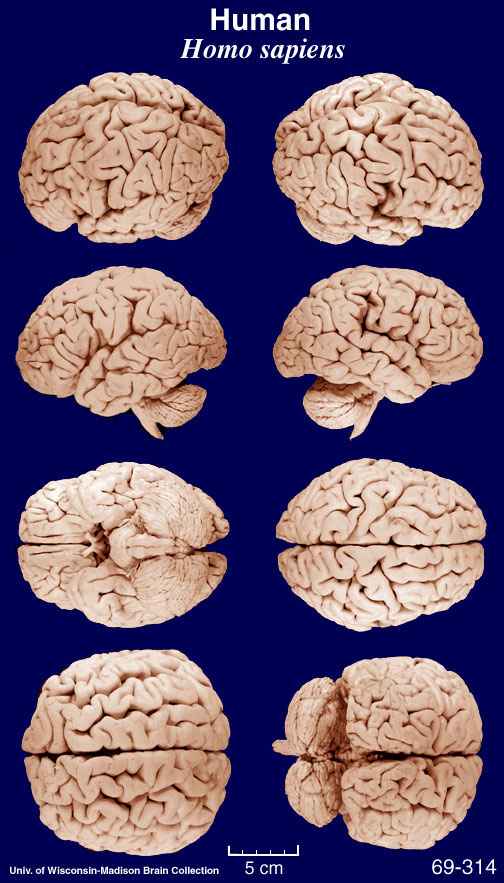
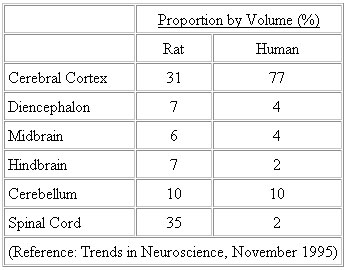
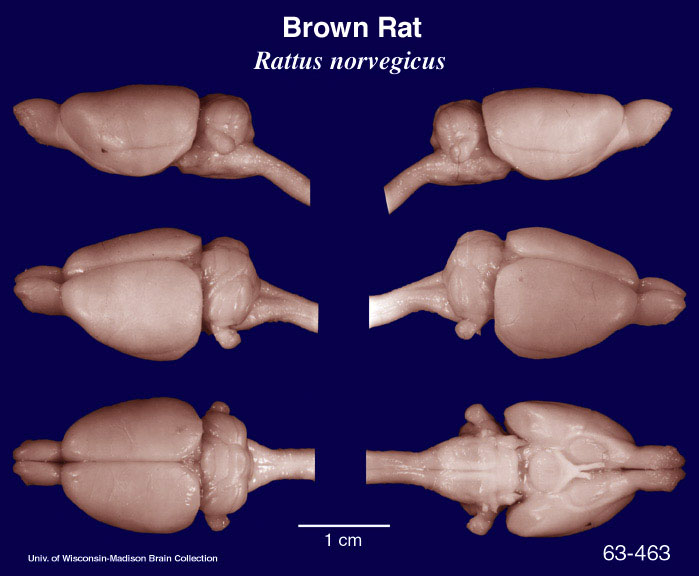
Like i said, the rat is more spinal cord than cortex, whereas the human is more cortical than spinal cord by a factor of nearly forty. Does anything else happen as we stagger up up the phylogenetic ladder? Well there’s a whole lot of crinkles added…
Rat:
Man:
Extending the war into Iraq would have incurred incalculable human and political costs. We would have been forced to occupy Baghdad and, in effect, rule Iraq. The coalition would instantly have collapsed, the Arabs deserting in anger and other allies pulling out as well. Exceeding the U.N.’s mandate would have destroyed the precedent of international response to aggression we hoped to establish. Had we gone the invasion route, the U.S. could still be an occupying power in a bitterly hostile land.
From “Why We Didn’t Remove Saddam” by George Bush [Sr.] and Brent Scowcroft, Time Magazine, 1998
Via IraqBodyCount.com. Let the record show: 10,000 civilian casualties so far.
Quotes #39 + #40
Two bits of classic Kerouac, the first from the beginning of ‘On the Road’
the only people for me are the mad ones, the ones who are mad to live, mad to talk, mad to be saved, desirous of everything at the same time, the ones who never yawn or say a commonplace things, but burn like
fabulous roman candles exploding like spiders across the stars.
and
What is the feeling when you’re driving away from people, and they recede on the plain till you see their specks dispersing? -it’s the too
huge world vaulting us, and it’s good-bye. But we lean forward to the
next crazy venture beneath the skies.
Some thoughts from a speech by Neil Gaiman:
Ignore all advice.
In my experience, most interesting art gets made by people who don’t know the rules, and have no idea that certain things simply aren’t done: so they do them. Transgress. Break things. Have too much fun.
Another piece of advice:
I’ve learned over the years that everything is more or less the same amount of work, so you may as well set your sights high and try and do something really cool.
more on cortical plasticity
The unexpected consequences of a noisy environment
Xiaoqin Wang
Trends in Neurosciences
Volume 27, Issue 7 , July 2004, Pages 364-366
Laboratory of Auditory Neurophysiology, Department of Biomedical Engineering, Johns Hopkins University School of Medicine
Abstract: A recent study found that the functional organization of auditory cortex was disrupted when rats were exposed to a moderate level of continuous noise during early development. However, this detrimental effect on auditory cortex could be remedied later by stimulating the noise-reared rats with structured sounds. These findings suggest that the endpoint of the ?critical period? could be extended well into adult life, which has significant implications for our understanding of cortical plasticity.
Rat vs Man
Thanks to Brain facts and figures
brain scamming
Nature discuss neuromarketing:
A more skeptic view of neuromarketing is that cognitive scientists, many of whom watched from the sidelines as their molecular colleagues got rich, are now jumping on the commercial bandwagon. According to this view, neuromarketing is little more than a new fad, exploited by scientists and marketing consultants to blind corporate clients with science
No one would do that, would they? Would they…?
Links for 29th June 2004
- Applet for calculating and visualising z-scores and probabilities on the normal distribution
- This guy got 11,000 rejection slips before he eventually got published. Woah.
- The Garden of Forking Paths
- A sheffield subvertiser’s story
- The Skeptic’s Dictionary on Neuro-Linguistic Programming
- Jim McCrone has a website!
- Real life invisibility cloaks – wow!
- Macho nonsense #94573: Does this guy know how silly he looks? (Actually the articles are pretty good).
- Because serendipity is too important to be left to chance via Matt
- The ten most difficult words to translate via Matt
- The effect of blogging on the media (requires registration, sorry)
- Brixton Cycles– great bike shop in brixton
- principles of Extreme programming
- James Atherton’s web notes on learning theory
post-text is pre-modern
It occurs to me that the post-modernist critics, with their obsession with text, are in fact profoundly modern. Treating words as objects, rather than events, analysing language as if it had some meaning in-itself, rather than as a dynamic relation to the world. Just like the literalists, the fundamentalists and their holy texts, the unreformed scientists and their static truths.
And before you say it, the more I hear the insistence that words are multiplicitious, the more i hear the binaries deconstructed, the more hollow it sounds. Such ardent disbelief in words feels too utterly entangled in the world of written words to escape – back to or onward to – the world of words as voiced actions.
Quote #37
Given what we know about the human brain, two facts stand out as astonishing: (1) We know very little about what distinguishes the human brain from that of other species; and (2) apparently, few neuroscientists regard fact 1 as much of a problem.
–Todd Preuss (2000). What’s human about the human brain? In The New Cognitive Neurosciences (M.S. Gazzaniga, Ed.), Cambridge MA: MIT Press.
Via Jody Culham
Unquiet emptiness (in image and words)
I went to the Edward Hopper exhibition at the Tate Modern on saturday. The unquiet emptiness of his paintings reminded me of this poem by Leonard Cohen
What I am doing here
I do not know if the world has lied
I have lied
I do not know if the world has conspired against love
I have conspired against love
The atmosphere of torture is no comfort
I have tortured
Even without the mushroom cloud
still I would have hated
Listen
I would have done the same things
even if there were no death
I will not be held up like a drunkard
under the cold tap of facts
I refuse the universal alibiLike an empty telephone booth passed at night
and remembered
like mirrors in a movie palace lobby consulted
only on the way out
like a nymphomaniac who binds a thousand
into strange brotherhood
I wait
for each of you to confess.
the hare of credulity
I blogged about this paper [1], last week, and alex had some very sensible things to say about it too, but basically my fear was that it would be that once outside the realm of academic discussion it would be seized as good evidence for a sixth sense. In fact the deeper story is that in the more tightly controlled studies the effect wasn’t present – a classic pattern for investigations of the paranormal and one that suggests to me that, if anything, the evidence is against the effect being a true one.
And how is the research reported in the Sunday Times [2] today? “There is a sixth sense…science has found evidence that people know when they are being observed”. The text of the article is a more balanced than the headlines, but it leaves me gritting my teeth as the hare of credulity outruns the tortoise of skepticism, again.
Refs:
1. Schmidt, S., Schneider, R., Utts, J. & Walach, H. (2004). Distant intentionality and the feeling of being stared at: two meta-analyses. British Journal of Psychology, 95, 235-247
2. The Sunday Times, 27th of April 2004, p9, “Didn’t you know it: there is a sixth sense”, John Elliott and Sarah Keenlyside
No language instinct
Geoffrey Sampson doesn’t believe in the language instinct. I remember reading his book Educating Eve in my final year at university and being splendidly, incoherantly, annoyed by his views on the nature-nurture debate. My girlfriend at the time had been set the book as part of her linguistics course and I singularly failed to express to her just how wrong-headed Sampson’s arguments were – how he completely failed to engage with the whole point of Pinker’s book., for one thing.
Of course I was fresh from reading things like Rethinking Innateness and had all the zeal of the new convert. I can’t remember the details of Sampson’s argument, and now I think i’d like to re-read it to check if i still feel the same way, and maybe to recapture that feeling of annoyance. Maybe my appreciation of it will have changed, I certainly think my appreciation of the language innateness debate has changed – i’ve had the luck to read Terance Deacon’s The Symbolic Species for a start, and that’s a book which should stretch anyone’s appreciation of language and brain evolution.
As an adolescent I aspired to lasting fame, I craved factual certainty, and I thirsted for a meaningful vision of human life – so I became a scientist. This is like becoming an archbishop so that you can meet girls.
Matt Cartmill – Professor of Biology, Duke University.
Via Don’t Dance with DNA
The reasonable man adapts himself to the world; the unreasonable one persists in trying to adapt the world to himself. Therefore all progress depends on the unreasonable man.
George Bernard Shaw (1856 – 1950), from Man and Superman (1903) “Maxims for Revolutionists”
BrainVoyager BrainTutor
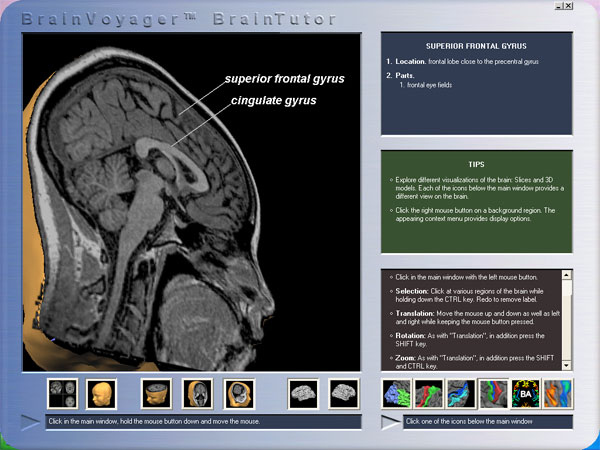
This is a screenshot of me playing with the BrainVoyager BrainTutor. BrainVoyager make fMRI analysis and visualisation software, and they’re kind enough to offer this interactive guide to different cortical regions for free.
Pictures can’t describe how much fun it is to play with, adding and removing the different hemispheres, labels, views, rotating the whole head, etc. It’s a shame they don’t have more areas programmed in at the moment (it’s just the lobes the gyri and sulci – but there’s a promising ‘forthcoming’ button for Brodmann areas).
Counseling the Procrastinator
New from APA books
Counseling the Procrastinator in Academic Settings
This new book discusses a number of recently designed practical counseling methods for use in academic settings. Over 70% of students in North America procrastinate! This new book describes practical counseling methods on procrastination, work habits, productivity, and self-regulation.
Just 70%?!
Links for 21st June
- I cannot quite understand how an economy can be stable when it contains such a huge and central instability as rocketing house prices and debt. Quite.
- The shopping myth – destructive, wrong and just plain insulting.
- Guardian profile of Amartya Sen from 2001 – ‘he prefers to be subversive in a technical way’.
- Guardian Profile of Daniel Dennet by Andrew Brown
- fire swords – way cool (AVI movies, 8MB each).
- Christian Jarrett
- Ellen Poliakoff
- All Models Are False, Some Are Useful. signal + noise
- Cool collection of quotes
- interdisciplines conference list
I think the great lesson of the 20th century is that you have to separate the ethics from the aesthetics… The great lesson there is that you don’t have to agree with what the Nazis did, but, yes, be honest about it, they did have the best uniforms. A lot of people can’t come to terms with something as banal as that.
Andrew Eldritch
We interrupt this webcast…
My home web-connection is down, so don’t nobody expect prompt replies to any emails sent, nor frequent blog posts. Hopefully will sort by the weekend…
update
Fixed it! That was far easier than i expected
Nothing I’ve ever written was anti-market. Being against the market is like being against conversation. It’s a form of exchange. But I was just as hostile in the past to giving any privileges to the market as I am now. Besides, those who are great advocates of the market don’t always make it easier for people to have access to the market through basic education, credit or whatever. (my emphasis).
Anomalous Data
It’s definitely an anomaly, but what kind of anomaly is it? In the British Journal of Psychology this month there is a meta-analysis of studies of electrodermal response to being stared at – or, to put it another way, a review of the evidence on whether we have a sixth sense to detect when people are looking at us. The review looked at two different paradigms and, quoting the conclusion:
We conclude that for both data sets that there is a small, but significant effect. This result corresponds to the recent findings of studies on distant healing and the `feeling of being stared at?. Therefore, the existence of some anomaly related to distant intentions cannot be ruled out. The lack of methodological rigour in the existing database prohibits final conclusions and calls for further research, especially for independent replications on larger data sets. There is no specific theoretical conception we know of that can incorporate this phenomenon into the current body of scientific knowledge. Thus, theoretical research allowing for and describing plausible mechanisms for such effects is necessary. [My emphasis].
So that’s okay then – just casually suggest that the entire physicalist basis of western science may be in error. Surely this result should either be better supported and in a better journal, or not published at all.
Thoughts anyone?
Ref:
Schmidt, S., Schneider, R., Utts, J. & Walach, H. (2004). Distant intentionality and the feeling of being stared at: two meta-analyses. British Journal of Psychology, 95, 235-247
Links for 18th of June
- They lied. They lied. They lied. And they’ll keep on lying.
- MP3 of Ani DiFranco’s poem about 9/11, Self-Evident.
- ‘The exam is History of Mankind.’
- Bush administration has used 27 rationales for war in Iraq, study says
- Increase Your Mental Ability with the HAPPYneuron Tool
- Corante : Loom on The genetics and chemistry of love
- steinsky.me.uk
- Literature, Cognition & the Brain, a web page featuring research at the intersection of literary studies, cognitive theory, and neuroscience
- Crooked Timber discussion on moral justification of torture (Hilarious)
- Secrets of successful neural aging: marathons, fornication and crosswords via boingboing
Science and Poetry
corante.com/loom on science, language, and ‘the reptilian brain’
The words we use, even in passing, to describe genes or brains or evolution can lock us into a view of nature that may be meaningful or misleading.
The brain suffers from plenty of bad language….[In Alchemy of the Mind, Ackerman] indulges in this sort of bad language a lot. One example: she loves referring to our “reptile brain,” as if there was a nub of unaltered neurons sitting at the core of our heads driving our basic instincts. The reality of the brain–and of evolution–is far more complex. The brain of reptilian forerunners of mammals was the scaffolding for a new mammal brain; the old components have been integrated so intimately with our “higher” brain regions that there’s no way to distinguish between the two in any fundamental way. Dopamine is an ancient neurotransmitter that provides a sense of anticipation and reward to other animals, including reptiles. But our most sophisticated abilities for learning abstract rules, carried out in our elaborate prefrontal cortex, depend on rewards of dopamine to lay down the proper connections between neurons. There isn’t a new brain and an old brain working here–just one system. Yet, despite all this, it remains seductive to use a phrase like “reptile brain.” It conjures up lots of meanings. Ackerman floods her book with such language, which I grouse about other bad language in my review.
Which makes me wonder, as a science writer myself: is all poetry is ultimately dangerous? Does scientific understanding inevitably get abandoned as we turn to the juicy figure of speech?
I say ‘no’. All language is imprecise to some degree. This is what gives it power- without imprecision you couldn’t have generality. To try and cut out all figures of speech would be to buy into the idea that perfect truth can be expressed in language, which is the sort of absolutist manifesto that leads to fundamentalisms of all sorts (including scienticism).
A good figure of speech can convey whole worlds of understanding, as well as being part of the fun that you need to motivate you to keep reading. Precision in scientific understanding is like democracy – something to always strive towards without fooling yourself that you’ve ever completely arrived.
So, yes poetry is dangerous, but so is trying do without it- any dealings with the ostrich-literalism of Creationists will demonstrate that.
Damn, I’m so liberal sometimes i make me sick.
The real problem with poetry is that people are given more license to get away with complete nonsense. But then the problem isn’t poetry – it’s nonsense.
London things
Some things for people in london in the next month or so:
Quote #32 – open secrets
There’s no secrets, just things I haven’t told you yet
Roger Grant, Aikido Instructor
Presenting my good side
Question: if i was going to put one of these photos on my CV, which one should i put?

And for bonus marks: which one is the real me?
We love sheffo
(Quoting andy) This is from ‘we love sheffo’ a new fanzine type thing about how great sheffield is…most of it is kind of about urban design / town planning, but it has a hip hop flavour too:
yo yo peeps this is real life and I’m a tell you about it. So me and my homes is chilling in the ponder rosa and hubs (he’s 2nd in command) is all ‘yo we need more 40s’. they all turns to me, you know, being il duce of the beats, so I hit my pops on the 2way – ‘urgent 40 call ponder rosa’ and he’s all like ‘i’ll pick you up when I drive by’. Got kind of excited at that part. Anyhoo, he rolls by in the mondeo and chaffeurs the don of rhymes (i.e. me) to Jacksons. I look but hey, I don’t know this stock, so I give Janice a heads-up. ‘where the 40s at ?’ and janice gets on the mike, spitting out ‘shelly, this young man’s looking for some 40s. do you know where they are ?’. I’m like yo, are we freestyling ? is this a battle ? D-stroy V Janice who’s hotter ? Holler back. But she’s all like ‘if you don’t stop grabbing that microphone I’ll fetch security’.
A brother can’t find no peace in Crookes.
genius !
Links for 15 June 2004
- http://www.nationmaster.com/ – ‘Where stats come alive!’
- Full marks to whoever did this UK subvert
- The Museum of Scientifically Accurate Fabric Brain Art
- 12 ways to degunk your PC
- Mind Changers (BBC)
- Live fast, die old : High metabolic rate gives mice a longer life
- Nocebo – the evil twin of the placebo effect
- Bill Bailey video clips
- More Bill Bailey video clips
- Good on-line guide to statistics tests
- Pathophysiology of the endocrine system – ebook
- Doonesbury from 1987: Return to Regan’s Brain